

Basic Concept
Occupational health and safety management is the basis of all our activities, as well as an important corporate foundation and corporate value itself.
The management and all employees of the Fujikura Group will place the highest priority on safety in work practices and work on creating a safe and comfortable work environment, maintaining and enhancing mental and physical health.
Furthermore, we will strive to ensure occupational health and safety for all workers, including dispatched and contracted employees, involved in our group's business activities.
Fujikura Group Occupational Health and Safety Policy
1. We will comply with legal and other occupational health and safety requirements.
2. We will set specific targets related to occupational health and safety, implement measures and evaluate the results, and make continuous improvements.
3. All divisions will conduct risk assessments and work to reduce risks.
4. We will promote maintaining and enhancing mental and physical health and support improving the working environment and the health management of employees so that they can work actively.
5. We will put the necessary resources to continuously improve our occupational health and safety management systems through consultation with and participation by employees.
Health and Safety activity promotion system
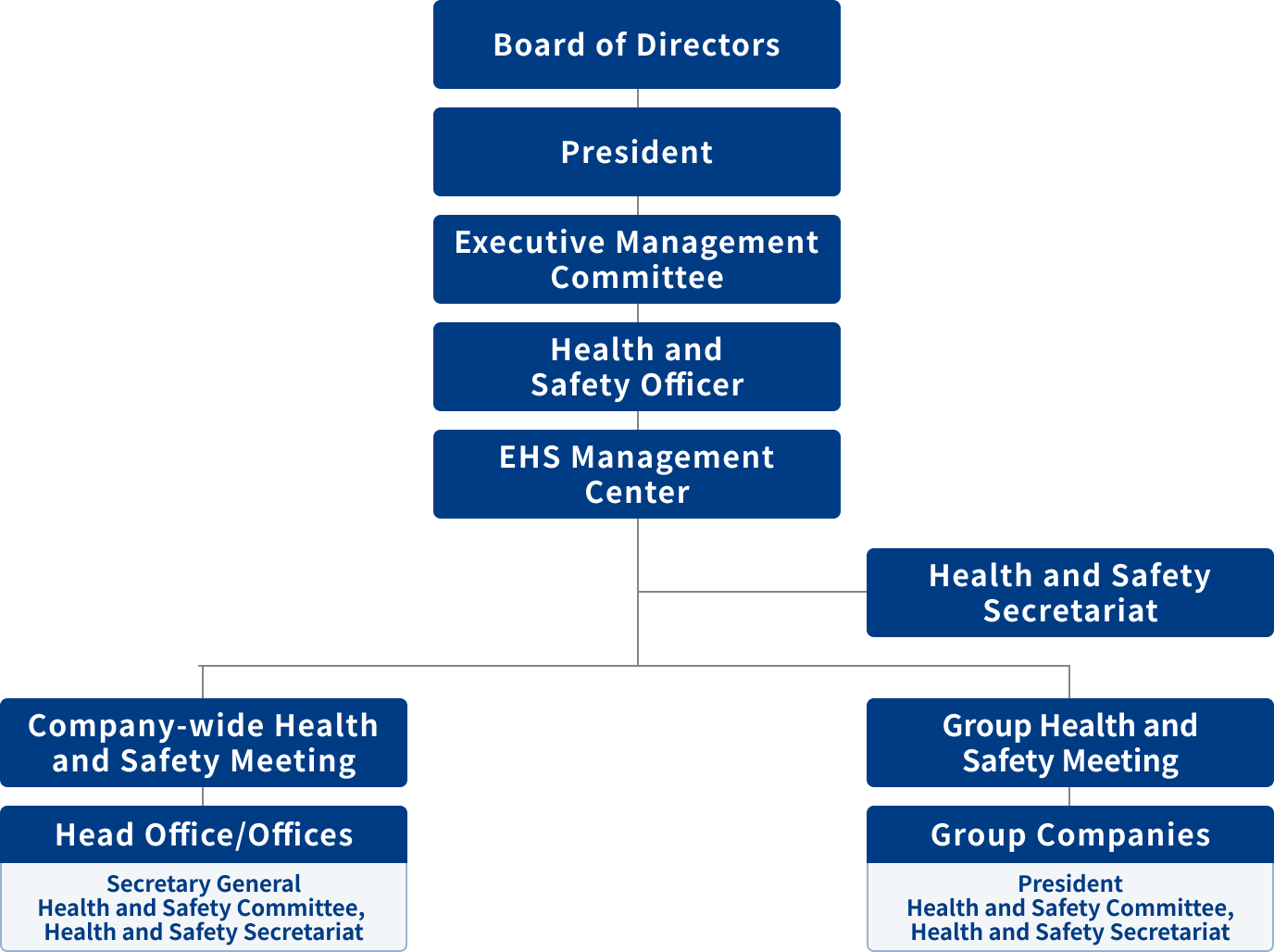
Fujikura Group health and safety activities are overseen by the Board of Directors. The Director, President and CEO, who is also a member of the Board of Directors, has overall responsibility for health and safety management. Under the Board's oversight, the Environment, Health and Safety Management Center, which promotes strengthened group governance and improved health and safety management. The Fujikura Group is working to improve health and safety management across the entire group, and in order to align the direction of these activities, it communicates messages from top management, shares various information such as accident information, and holds the "Fujikura Group Health and Safety Conference" twice a year as an opportunity for health and safety managers from each site to discuss matters.
establishment of "Safety Pledge Day"
In response to a serious accident that occurred at a domestic related company in April 2016, Fujikura Group employee to pledge a strong commitment to safety and to "never let a serious accident happen again," and issued the "Safety Pledge" below. Every year on the same day, the Fujikura Group establishment "Safety Pledge Day" (a message from the Director, President and CEO) to all group companies both in Japan and overseas, and by reciting the "Safety Pledge," we hope to pass on the story of this serious accident and ensure it is not forgotten.
Safety Pledge
- We will never let the same disaster happen again!
- We prioritize safety in everything we do!
- We will create an accident-free workplace for our colleagues and their families!
Health and Safety Activity Slogan
Fujikura Group sets a new slogan for its health and safety activities every year and works to continuously improve the workplace environment and maintain and promote physical and mental health. For fiscal 2026, the slogan will be "If you sense danger, don't hesitate to share your concerns, and let us all work together to ensure safety in the workplace!" and top management has issued a message calling for the implementation of key safety and health measures at each base.
Health and Safety Initiatives
Inherent safety and risk assessment
In health and safety management, proactive activities such as risk assessment are positioned as important activities to reduce occupational accidents. Since 2016, the Fujikura Group has been continuously conducting risk assessment activities using a common methodology across all its operations, including overseas locations. This has become an established and unified activity, regardless of the nature of the business or the size of the facilities. Risk reduction activities are conducted for identified risks based on the concept of inherent safety. All risks are managed and analyzed in a database system and utilized to promote risk reduction activities. The number of risks has increased from about 33,000 at the beginning of the data collection to more than 55,000 (including those that have become acceptable risks) as of the end of March 2026, an increase of about 66%. We will continue to work on potential improvement activities without slowing down.
We will continue to strengthen our activities to identify potential risks without slowing down, with the ultimate goal of "bringing all risks to an acceptable level.
Utilizing the Occupational Health and Safety Management System
We have been operating an OHSMS (Occupational Health and Safety Management System) since fiscal 2010, and in fiscal 2022 we obtained certification for the Occupational Health and Safety Management System standard (ISO45001-2018) within a framework that integrates our head office and each works of Fujikuta. The certification applies not only to Fujikura employee, but also to all parties who enter and leave each works (non-regular employees, contractors, customers, service providers, etc.). We are effectively incorporating the requirements of the standard into operational improvements and efficiency in each business, and are utilizing the management system to ensure continuous improvement in order to build and foster a mutually enlightened safety culture in which all Fujikura employee can proactively point out each other's dangerous behavior.
For more details Click here
*OHSMS: Occupational Health and Safety Management System
Occupational accidents and preventative measures
In fiscal year 2025, the Fujikura Group reported zero fatal work-related accidents and seven work-related injuries resulting in lost work time.
For these occupational accidents, we have analyzed the causes and implemented thorough preventative measures. Furthermore, we are working to improve our health and safety management levels by sharing this accident information across the entire group and implementing horizontal deployment strategies.
For more details Click here
Other major activities
The EHS Management Center regularly conducts OHS patrols at all of its domestic and international locations with the aim of monitoring health and safety management activities at group company locations, confirming the status of identified risks, and providing various guidance. In relation to this, in order to grasp the activities at each site without omission, we have set up a system to collect necessary information at each site side by side by using the Environment, Health and Safety survey form. This Environment, Health and Safety survey form has been made more effective by updating the questions every year, and is also effectively used for health and safety patrols. We have been trying to prevent recurrence and similar accidents by sharing accident cases. In recent years, the number of accidents has been decreasing significantly due in part to the effects of the essential safety application, and we are also making efforts to share information on near-misses.
In addition, to foster a culture of safety, we are developing activities to raise the safety awareness of all employees at Fujikura and Group companies and to improve their competence. Hazard simulation training is said to be highly effective in improving sensitivity to danger, and by sending portable equipment to each Group site, a total of more than 9,000 employees will have taken the training by FY2025, making it an effective means of education.
Recently, heatstroke prevention has become particularly important in terms of health and safety. The Fujikura Group has established standards for the WBGT value (heat index), which indicates indoor heat, and is actively promoting the introduction of air conditioning equipment at each of its factories. Furthermore, in order to address labor shortages and the aging workforce, we are working to improve the working environment and aim to create a workplace where everyone can work with peace of mind.
Various initiatives to strengthen disaster prevention and countermeasures
Group Crisis Response/Disaster Prevention Review Meeting
The purpose of the meeting is to report, discuss and conduct training regarding Fujikura Group 's disaster countermeasures and crisis preparations.
防災ガイドラインの策定、PDCA活動の推進
フジクラの各事業所および各グループ会社における地震や台風等の自然災害への対策強化を目的とした「フジクラグループ防災ガイドライン」を策定し、各拠点の危機対応力の維持・強化に向けたPDCA活動を推進しています。
Headquarters Disaster Prevention Headquarters Training
本訓練は、首都直下型地震が発生した際に本社における人命安全・二次災害防止等の活動を担う本社災害対策本部各班の行動手順について、実際にシミュレーションを行い、災害時の体制が有効に機能するかの確認・検証を目的として実施しています。訓練では、地震発生以降の対策本部各班員の参集からスタートし、各班員の迅速な参集、本部機能に必要な機器の速やかな準備を経て、対策本部を設置します。各班員が役割に応じた個別手順等、災害時に想定される手順を実際に行動することにより、本部員は自らの役割や手順を確認・習得します。
本部では、社員の安否確認、建物やインフラの状況、周辺の交通状況等の情報を収集し、発生する諸問題への対応策の検討を通じて情報整理の難しさや重要性等を体感し、今後の改善に向けた課題を抽出します。訓練終了後には、各班より出された課題や反省点、次回につながる改善点等を共有の上、備品の準備や手順書の修正等の継続的な改善活動を行っています。
Disaster prevention training
As part of disaster prevention measures for the entire Fujikura Group, evacuation drills are conducted at the Head Office, Sakura business, Suzuka business and other locations, assuming major earthquakes such as a major Nankai Trough earthquake or an earthquake directly beneath the capital, in an effort to raise disaster prevention awareness.
Safety confirmation system and carrying a portable disaster prevention card
Fujikura believes that "each and every Fujikura employee is an important asset of Fujikura Group, irreplaceable by anything." Based on this belief, Fujikura is implementing various disaster prevention and mitigation measures in preparation for major natural disasters, such as the predicted imminent Nankai Trough megathrust earthquake and the Tokyo metropolitan area earthquake. Examples of these efforts include a safety confirmation system and portable disaster prevention cards.
Safety confirmation system
Fujikura has had a safety confirmation system in place to confirm the safety of Fujikura employee and their families in the event of a disaster since 2010. Information collected through this system is promptly reported to top management and used in BCP.
Portable disaster prevention card
Fujikura distributes disaster prevention cards to all Fujikura employee to protect themselves from major disasters such as earthquakes. The cards contain information such as actions to take in the event of a major earthquake (by affected area), a disaster prevention checklist, and how to respond to the safety confirmation system.