

Basic Concept
フジクラグループでは、グローバルに事業活動を行ううえで、世界人権宣言などで定める基本的人権を尊重することを「フジクラグループ人権方針」の中で明示しています。
また、人権に関する方針や施策の立案にあたっては、国連「ビジネスと人権に関する指導原則」「OECD多国籍企業行動指針」「労働における基本的原則及び権利に関するILO宣言」「国際労働基準」、ユニセフ「子どもの権利とビジネス原則」といった国際的な原則も参照し、人権に対する理解の促進と実現に努めています。
Fujikura Group Policy on Human Rights
Fujikura Group is living up to the trust of customer around the world and contributing to the development of the international community through its "Tsunagu" Technology™. We fully understand that the human rights of all people affected by our global business activities must be protected, and we respect human dignity and all internationally recognized human rights.
This Human Rights policy is based on Fujikura Group 's Corporate Philosophy and Code of Conduct and declares our responsibility to respect human rights.
1. Respect for international norms
Fujikura Group supports and respects international standards on human rights, such as the International Bill of Human Rights, which defines the basic human rights that all people around the world should enjoy, and the ILO Declaration on Fundamental Principles and Rights at Work, which stipulates basic rights at work. In addition, we have established the Fujikura Group Human Rights Policy (hereinafter, this policy) based on the United Nations Guiding policy on Business and Human Rights, and will promote efforts to respect human rights.
2. Responsibility to Respect Human Rights
If Fujikura Group 's business activities result in an adverse impact on human rights, or if it becomes clear that it has contributed to such an impact, it will fulfill its responsibility to respect human rights by taking appropriate remedial measures to correct the impact and by taking preventive and mitigating measures.
Fujikura Group will appoint an individual to be responsible for implementing this policy, and that individual will be responsible for overseeing compliance with this policy.
3. Scope of application
This policy is application to all Fujikura employee of Fujikura Group officers and employees, including full-time, contractual, and temporary Fujikura employee, including full-Fujikura employee, Fujikura employee contractual, and temporary . In addition, if the negative impact on human rights by our business partners or other stakeholders is directly linked to our business activities, we will ask these partners to respect human rights and take measures to avoid infringements.
4. Compliance with application Laws and Regulations
Fujikura Group will comply with the laws and regulations application in each country and region it conducts business in. In the event of a conflict between internationally recognized human rights and the laws and rules of each country or region, we will respect internationally recognized human rights principles while giving as much consideration as possible to the laws and rules of each country or region.
5. Human Rights Due Diligence
Based on the United Nations Guiding Principles on Business and Human Rights, Fujikura Group will conduct human rights due diligence to identify, prevent, and mitigate actual or potential adverse impacts on human rights caused by its business activities.
The human rights due diligence process includes assessing actual or potential human rights impacts, considering and implementing measures based on the results of the assessment, verifying the effectiveness of those measures, and publishing any further actions based on the verification of their effectiveness.
Furthermore, we will continually conduct human rights due diligence, recognizing that adverse impacts on human rights may change depending on business situation of Fujikura Group.
6. Education
Fujikura Group will continue to provide appropriate education and raise awareness among its officers and all employees to ensure that this policy and human rights due diligence are well understood and effectively implemented throughout its business activities.
7. Dialogue and consultation
In implementing this policy, Fujikura Group will utilize external human rights expertise and will proactively engage in dialogue and discussions with stakeholder who are adversely affected by actual or potential human rights issues in our business activities to identify issues and to discuss efforts to improve them.
8. Disclosure of Information
To fulfill its accountability regarding this policy, Fujikura Group will report on the status of its human rights efforts in its Corporate Social Responsibility (CSR) reports and on its website.
Basic principles of personnel policy
Fujikura Group 's basic philosophy is to accurately grasp the needs of customer, Fujikura employee, and society and reflect them in its personnel policies and systems in order to build win-win relationships between the three parties.
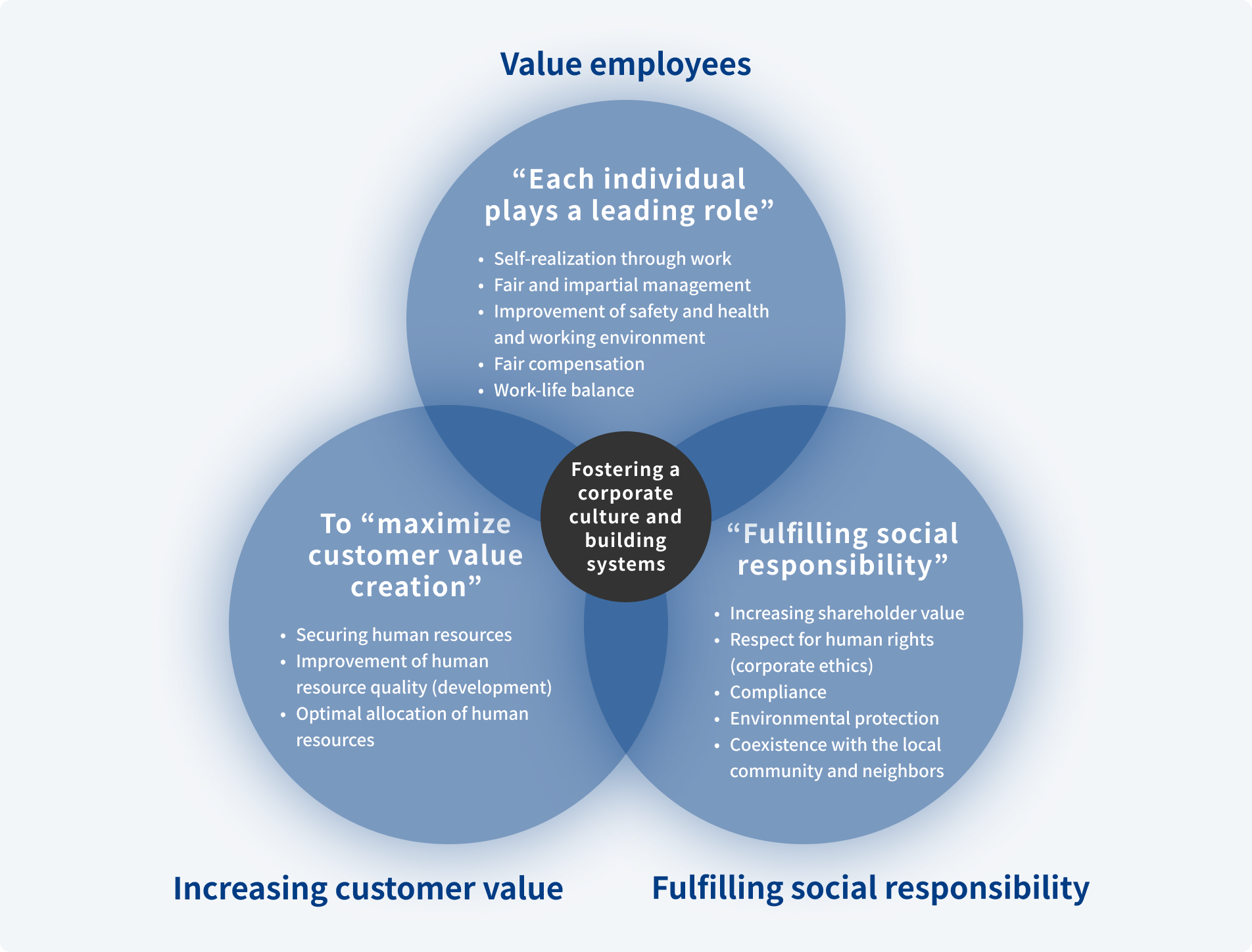
Group HRM Vision
In order to continue to grow and prevail in the global market, Fujikura Group establishment the Group HRM Vision in September 2017 as the starting point and compass for human resource management.
establishment of the HRM Vision clearly states and declares, both inside and outside the company, that we will accelerate the securing and promotion of global human resource, create an environment in which all Group Fujikura employee can feel a sense of growth and self-actualization through their work, provide career opportunities regardless of nationality, race, gender, religion, age, etc., promote diversity so that human resource with diverse backgrounds and ways of thinking can play an active role, and work to develop global leaders, etc. We are communicating this to each Group company through Group HR unit liaison meetings, etc., to ensure that it is fully understood.
Group HRM Vision "Everyone working at Fujikura Group is an asset"
human resource
We will hire, develop, and treat Fujikura employee who have a strong sense of ownership and who act as the main players.
Desired behavior
We will promote the creation of organization diverse human resource can thrive, regardless of nationality, race, gender, religion, age, etc.
Diversity
We encourage each Fujikura employee to respect each other, cooperate and encourage each other, and lead change.
Opportunity provision
We will seek out human resource necessary for the further growth of the Group from around the world, provide them with opportunities, and select them for promotion.
Standards for Fujikura employee safety and health management and ethical considerations
Based on the Fujikura Group Corporate Philosophy (MVCV), Fujikura Group has established standards for Fujikura employee health and safety management and ethical considerations, stipulating respect for human rights and the creation of a comfortable working environment, and promoting the creation of a vibrant workplace where diverse human resource can thrive.
Standards for Fujikura employee safety and health management and ethical considerations
- Prohibition of child labor and restriction of youth labor
- Prohibition of forced labor
- Non-Discrimination
- Prohibition of corporal punishment, abuse and harassment
- Appropriate management of working hours
- Promoting a safe and healthy working environment and health management
- Providing fair and equitable compensation
- Respect for workers' rights
Compliance with the UK Modern Slavery Act
In response to the UK law "Modern Slavery Act 2015," Fujikura Group formulated the "Fujikura Group UK Statement on Modern Slavery and Human Trafficking" in 2017. Since establishment the statement, we have been disseminating it globally via our company intranet to raise Fujikura employee awareness.
Protecting human rights through business activities
Promoting human rights due diligence
Fujikura Group takes internal measures when human rights issues become apparent through a whistleblowing system and partner meetings with business partners in accordance with the Fujikura Group Human Rights policy. In recent years, in order to protect human rights and ensure transparency in business activities such as procurement and manufacturing, there has been a need to promote human rights due diligence, and we have established a human rights due diligence system in accordance with the procedures set forth in the "Guiding Principles on Business and Human Rights" and are working to review it regularly.
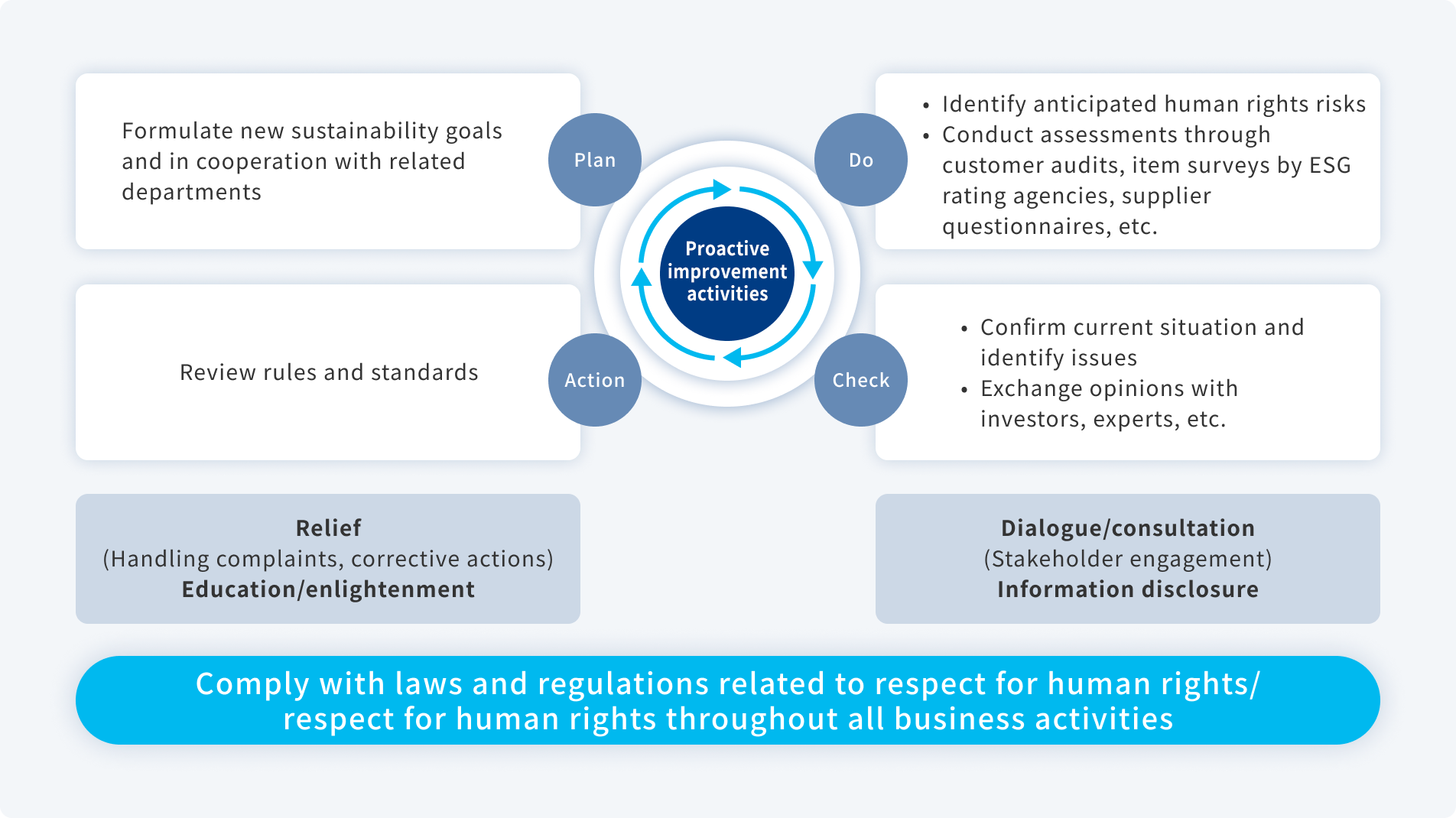
Identifying potential human rights risks and periodically reviewing them
フジクラグループは、人権に関する国際的なガイダンスや顧客からのアンケートおよびESG評価機関の調査票などを参考に、事業活動に関連して留意すべき人権上の課題を整理し、その状況を定期的に確認しています。
あわせて、労働安全衛生や労働時間管理等については、ISOに基づく監査を通じて状況を確認しており、これらの結果を踏まえ、人権への負の影響の回避・予防・軽減に向けた取り組みを進めています。
人権リスクの把握にあたっては、調達、製造・職場、顧客対応および製品に関わる各事業活動の特性を踏まえ、サプライヤとの対話やアンケート、内部通報制度および専門部門による内部監査、顧客からの監査や指摘内容の確認等を通じて、課題の把握と必要な是正につなげています。
Anticipated human rights risks related to Fujikura Group 's business activities
| business Activities | Procurement | manufacturing | sales |
|---|---|---|---|
| Human rights risks | Child labor, forced labor, abuse of preferential treatment, discrimination, non-payment of wages, unfair dismissal, health and safety, etc. | Occupational safety and health, labor-management relations, foreign workers, freedom of association, harassment, etc. | Product safety and quality, human rights violations due to unintended use, etc. |
| Stakeholder | Suppliers, local communities | Group Fujikura employee | customer, local communities |
| business impact | Impact on stable procurement and risk of losing customer | Declining engagement | Damage to brand value |
| Risk Identification | Communicating with suppliers through partners' meetings and conducting surveys | Utilizing the internal reporting system, internal audit by specialized unit, and responding to RBA audits by customer | Understanding trends in human rights-related bills |
これらのリスクについては、各テーマに関する方針および取り組みを通じて、回避・予防・軽減に向けた対応を実施していきます。
Responding to customer questionnaires and RBA audits
Fujikura Group aims to build long-term, sustainable relationships with customer, and responds to requests from customer by completing sustainability questionnaires and RBA questionnaires, on-site audits, etc. We are particularly focused on responding to RBA audits, and by taking the feedback seriously and responding promptly, we are able to gain the trust of customer and identify and correct any human rights risks in our business activities.
Understanding social demands using questionnaires from ESG rating agencies
Fujikura Group proactively responds to surveys received from ESG rating agencies to understand the current situation and respond to society's demands. By analyzing the different evaluations given by each ESG rating agency, we are able to identify issues, such as the actions and information disclosure required of companies, and use this information to strengthen our management foundation.
Wage management for local employment
Fujikura Group In establishing or expanding production bases, Minebea hires locally in order to contribute to local social and economic revitalization through the creation of jobs.
In accordance with the labor laws and collective labor agreements of each country, each company stipulates appropriate wages, commuting and other allowances, bonuses, other temporary salaries, and retirement benefits.
For managerial positions at Fujikura and major related company companies, we have introduced a "role grading system" in which compensation is determined based on "the job or role currently held," and there is no gender-based disparity in the compensation system.
Overseas, each country has established rules that complies with all wage-related laws and regulations regarding minimum wages, legal benefits, overtime, etc., and operates in accordance with these laws and regulations, and pays employees at the determined payment period and time.
stakeholder engagement on human rights issues
Based on the Fujikura Group Human Rights policy, Fujikura assesses potential human rights impacts, considers and implements countermeasures, discloses information, etc., and exchanges opinions with institutional investors and others on ESG-related topics, including business and human rights.
Through communication, we deepen our understanding of human rights risks related to business activities and use them for future measures.
Initiatives for human rights in procurement activities
As corporate activities become increasingly globalized, social responsibility is being called into question not only Fujikura but also throughout the supply chain. Fujikura Group is working on CSR procurement, including matters related to human rights.
For details, please refer to "Procurement Activities."
Raising awareness within the company about business and human rights
フジクラグループでは、「フジクラグループ行動規範」の役員を含む全社員への浸透活動を通じて、人権尊重意識の醸成と人権問題への理解を促進することを目的に啓発活動を続けています。
フジクラでは、「フジクラグループ 人権方針」に基づき、フジクラ本体の役員および従業員を対象とした人権教育を毎年実施しています。人権教育では、国際的に認められた人権原則を踏まえ、差別の禁止、ハラスメントの防止、強制労働・児童労働の禁止、適正な労働時間管理、安全で衛生的な職場環境の確保など、事業活動に関連する基本的な人権課題を幅広く取り上げています。教育は、eラーニング等を活用して実施しており、役員および従業員が人権に関する基本的な考え方に加え、自身の業務において人権を尊重するために求められる行動や留意点について理解を深めることを目的としています。
これらの継続的な取り組みを通じて、人権尊重の意識を組織全体に浸透させるとともに、人権リスクの未然防止につなげています。
| Target Audience | Main Contents |
|---|---|
| For all Fujikura employee | 12月10日「世界人権デー」に合わせた「世界人権デー・キャンペーン」を毎年実施。人権への理解・啓発を目的としたeラーニング研修の実施 |
| For Executives | The Sustainability Promotion committee discusses priority issues for each sustainability theme, including human rights. |
| For new Fujikura employee | Conduct basic training on sustainability and promote understanding and discussion of the SDGs |
| For Procurement a person in charge | Understanding the content of CSR Procurement guideline and sharing basic information on "Business and Human Rights" |
Establishment of a consultation desk for Fujikura employee
Fujikura has set up a "Harassment Consultation Desk," an "Internal Reporting System," an "Internal Reporting Desk Fujikura Group Overseas Bases," and a "Childcare/Nursing Care Consultation Desk." In addition to internal reporting, we have established a system to accept various reports and consultations, including any issues related to human rights, discrimination, and harassment that Fujikura employee may have in the workplace, and we aim to detect, resolve, and correct problems early. Anonymous consultations are also accepted, and a system is in place that allows employees to consult directly with an outside lawyer.
Initiatives to prevent harassment
Fujikura Group has establishment the "Fujikura Group Harassment Prevention Policy," and as part of its efforts, has established a harassment consultation desk, put in place a consultation flow, and is conducting awareness-raising activities through training for newly appointed managers, implementing e-learning, etc. In addition, the Group has established an internal reporting system both in Japan and overseas, and if any harassment is confirmed, disciplinary action is taken in accordance with the work rules, etc., and in accordance with regulation, personal information is made public in a form that does not identify the employee, and the information is made known within the company.
Fujikura Group Harassment Prevention Policy
1. We do not tolerate harassment of any kind.
2. In order to provide a comfortable and pleasant working environment for all employees, we will implement the following:
- We will conduct educational and awareness-raising activities to prevent harassment.
- We will set up a consultation and complaint desk for harassment to widely accept inquiries and complaints.
- We will promptly investigate any inquiries or complaints, while respecting privacy. In addition, we will not treat anyone unfavorably for having made an inquiry or cooperated in the investigation of the facts.
- If any harassment is discovered, we will deal with it promptly and strictly and take measures to resolve the issue and prevent recurrence.
In-house promotion through the World Human Rights Day campaign
フジクラグループでは、12月10日の「世界人権デー」にあわせて、「世界人権デー・キャンペーン」を毎年行っています。本キャンペーンは人権意識の啓発と「フジクラグループ人権方針」の社内浸透などを図るために、国内外で人権ポスターを掲示しています。また、社内イントラネットで国連「世界人権宣言」ならびに「世界人権デー」を制定した経緯などを伝え、グループ社員に人権について考える機会としています。
加えて、フジクラでは人権への理解・啓発を目的としたeラーニングを実施しており、人権意識の向上に努めています。
eラーニングの実績については、こちらをご参照ください。
Labor-management relations that emphasize sufficient consultation
Fujikura considers the "freedom of association" and the "right to collective bargaining" to be fundamental human rights that should be respected as a company. In the collective labor agreement concluded between Fujikura and the Fujikura Labor Union, the union is allowed to retain the right to organize, bargain collectively, and dispute. In addition, Fujikura is committed to building a relationship of mutual trust between labor and management by discussing each other's positions with respect. Regarding management policy and business plans, management measures and business policies, we hold "management briefings" and "labor council meetings" as appropriate, where management provides sufficient explanations to the labor union and fully exchanges opinions to deepen understanding between labor and management while working to resolve issues. In addition, training sessions are regularly held on the management environment surrounding Fujikura, the company policy and the labor union movement policy, with labor union leaders, the president, and the heads of each business units department as lecturers. Working conditions (e.g., realization of reforms in work styles) are also determined at the Labor Council through exhaustive discussions to reach a consensus between labor and management.
Opportunities for communication
- Management briefing (twice a year)
- Labor council (held as necessary): quarterly settlement of accounts results, monthly profits, production status, labor status, working conditions, etc.
- Labor-management training session (once a year): Corporate Philosophy and policy, labor union movement policy, etc.
- Collaboration with related company (held as necessary): Exchange of opinions with labor and management related company