

Press Releases
Fujikura and Proxima Fusion Sign MOU to Explore an HTS Manufacturing Base for Fusion in Germany
Fujikura Ltd. (Director, President and CEO: Naoki Okada; hereinafter “Fujikura”) has signed a memorandum of understanding (MOU) with Proxima Fusion GmbH, a Germany-based company developing stellarator*1fusion power plants, to jointly explore the stable supply of high-temperature superconducting (HTS) tape and the feasibility of local production.
Under the MOU, the companies will combine Fujikura’s long standing expertise in HTS tape technology and manufacturing, together with Proxima Fusion’s long-term demand and technical requirements for fusion power plants. They will assess the technical, commercial and economic feasibility of a manufacturing base as a foundation for a resilient HTS tape supply platform in Europe.
・Fujikura and Proxima Fusion will jointly explore the stable supply of HTS tape and the feasibility of local production.
・The companies will combine Fujikura’s HTS technology and manufacturing know-how with Proxima Fusion’s insight into long-term demand and technical requirements, with the aim of establishing a supply platform in Europe.
・ Through this initiative, the companies seek to strengthen the supply chain essential to the deployment of fusion energy*2 and contribute to deeper industrial cooperation between Japan and Germany.
Background to the MOU
Fusion energy requires ultra-high-temperature plasma to be confined and controlled by powerful magnetic fields. HTS tape is an essential material used in superconducting magnets that generate such fields, and it plays an important role in enabling compact, high-field fusion power plants.
As fusion moves from research to commercialization, global demand for high-performance HTS tape is expected to grow. Meeting this demand will require not only expanded production capacity, but also stable and resilient supply chains across multiple regions.
Building on research achievements from the Wendelstein 7-X program at the Max Planck Institute for Plasma Physics, Proxima Fusion is developing fusion power plants based on the QI-HTS stellarator concept. Proxima Fusion has raised more than EUR 650 million to date, making it the best-funded fusion company in Europe. The company expects to require approximately 20,000 kilometres of HTS tape for “Alpha,” its demonstration device currently under development, and approximately 40,000 kilometres for each future commercial “Stellaris” power plant.
Scope of the Joint Study
Under the MOU, the companies will conduct a phased assessment of the technical and economic feasibility of stable HTS tape supply and local production, primarily in Germany.
Comments from the Companies
Francesco Sciortino, CEO and Co-founder, Proxima Fusion GmbH
“Germany and Europe have made a clear choice to lead in fusion. But a fusion power plant’s supply chain has to be in place years before the plant itself. That is why we are working on HTS tape now, for Alpha, our net-energy stellarator demonstrator, and for Stellaris, the first stellarator-based fusion power plant. Fujikura is a clear leader in the manufacturing of high-temperature superconductors, and we are proud to be working with them to bring this capability to Germany. This is how Europe builds its fusion supply chain: step by step, with reliable, long-term commitment to the best partners in the world.”
Naoki Okada, President and CEO, Fujikura Ltd.
“For many years, Fujikura has advanced the research, development and manufacturing technology of HTS tape and supplied products that support fusion energy development around the world.
The deployment of fusion energy will require an industrial foundation capable of supplying high-performance HTS tape reliably and at scale. Through this MOU, we will apply Fujikura’s accumulated HTS technology and manufacturing expertise to assess the feasibility of establishing a supply platform in Germany and across Europe. By working together, we aim to contribute to the practical deployment of fusion energy and the realization of a sustainable energy future.”
About Proxima Fusion GmbH About Proxima Fusion GmbH
Proxima Fusion is Europe’s leading stellarator company and the first spin-out from the Max Planck Institute for Plasma Physics. The company is developing commercial fusion power plants based on the QI-HTS stellarator concept, building on the scientific breakthroughs of the Wendelstein 7-X programme. With Alpha, Proxima is developing a net-energy fusion demonstrator targeted for the early 2030s, paving the way for Stellaris, the world’s first commercial stellarator fusion power plant later that decade. This ambition is supported by the Alpha Alliance, a consortium of more than 50 industrial partners, and a distinguished Industrial Development Board. Headquartered in Munich, with offices in Zurich and Oxford, Proxima employs around 200 people across engineering, science and operations.
Head office: Munich, Germany
Representative: Francesco Sciortino, CEO and Co-founder
Business: Research and development of stellarator fusion power plants
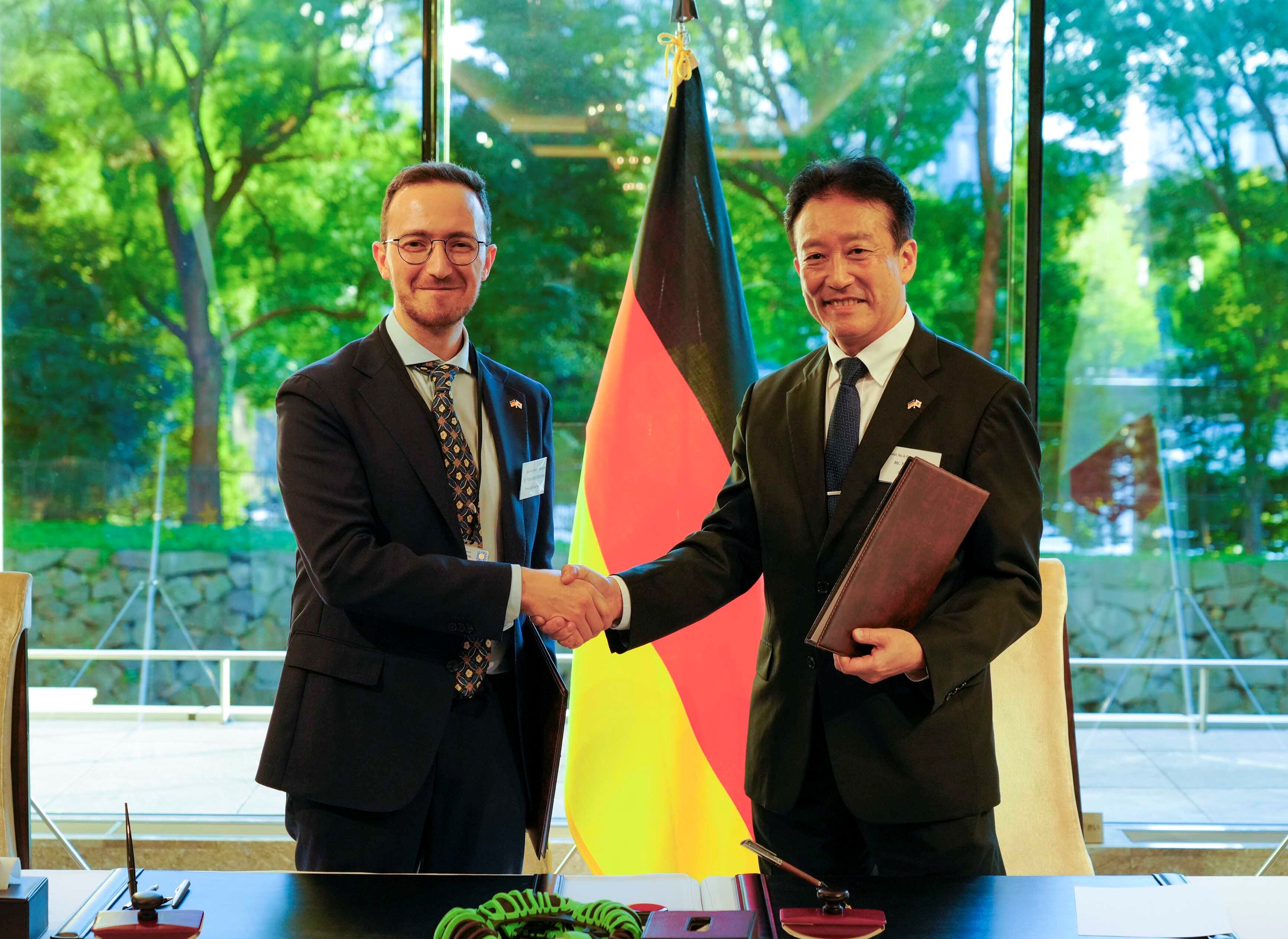
A memorandum of understanding was signed in Tokyo
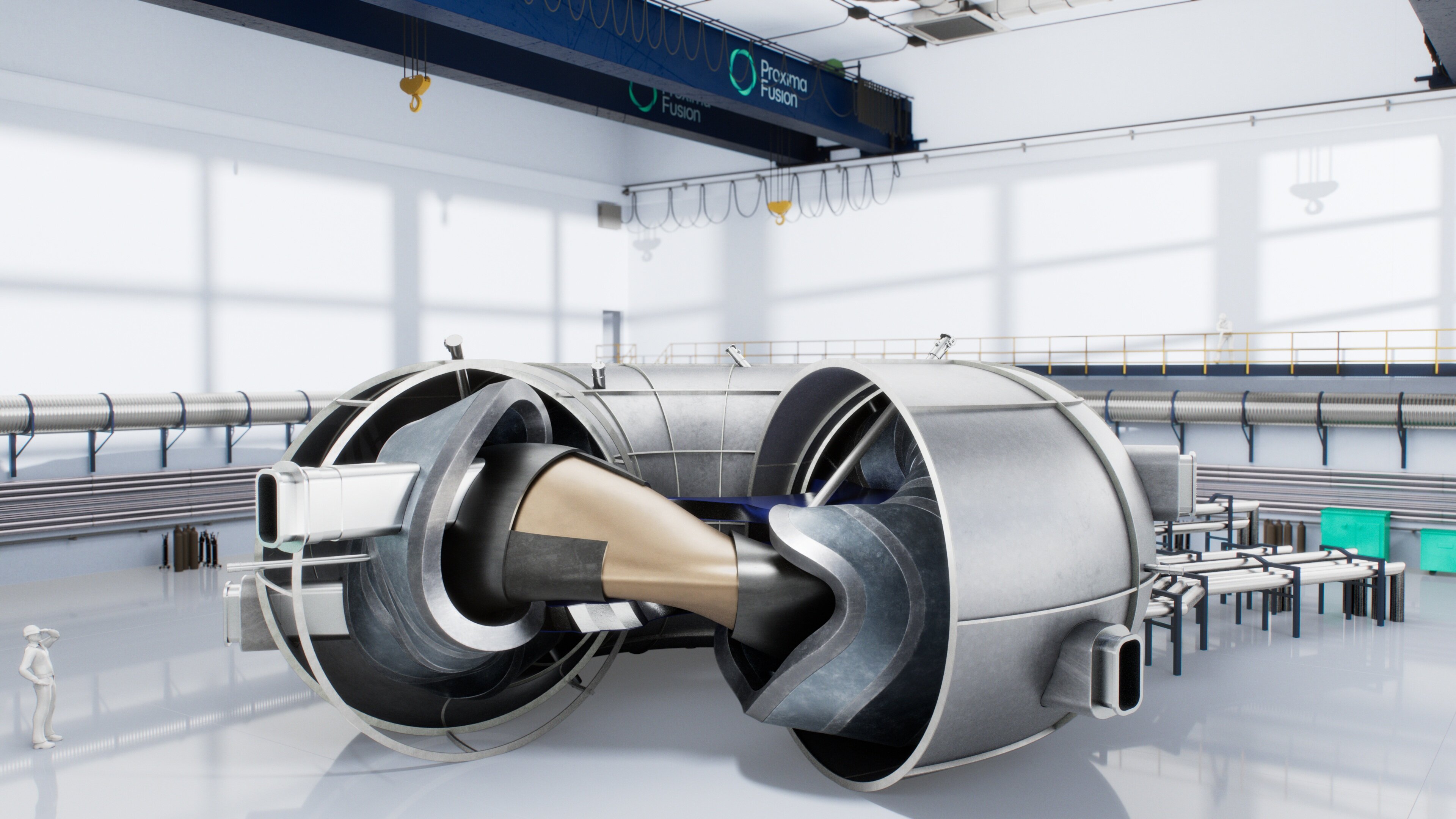
Conceptual image of Alpha, the fusion demonstration device under development by Proxima Fusion
*1 Stellarator
A stellarator is a type of fusion energy device that confines ultra-high-temperature plasma using magnetic fields generated by external coils with complex three-dimensional shapes. Because it does not require a large current to flow through the plasma, it is inherently suited to stable, long-duration continuous operation. At the same time, forming the required magnetic field calls for high-precision magnets with complex geometries. Germany’s Wendelstein 7-X is the world’s largest stellarator and is used to investigate the applicability of this approach to future power plants.
*2 Fusion energy
Fusion energy is released when light atomic nuclei, such as deuterium and tritium, fuse to form another nucleus, such as helium, in a reaction similar to that occurring in the Sun. Deuterium, one of the fuels, is abundant in seawater, and the power-generation process does not emit carbon dioxide (CO2). Because a small amount of fuel can produce a large amount of energy, fusion energy is also expected to face relatively few resource constraints and to contribute to long-term energy security. Research and development are therefore progressing worldwide as fusion is viewed as a next-generation energy source that could support the transition to a carbon-neutral society.
