


Vol. 02
No.1 share in the world
The story of the development of the de facto standard "Fusion Splicer"

Phase 1
Visionary
Fujikura's Fusion Splicer business now holds the number one share in the world and maintains a position that could be called the de facto standard. However, it began with a series of hardships.
Fujikura's "Fusion Splicer" has been widely used in countries around the world and has become a global standard in both name and reality. Due to the need for high-performance Optical Fiber and the need for high-quality connectivity, further technological evolution is required, and now the possibilities for business are expanding significantly. Today, Fujikura's Fusion Splicer business has strategy partner agents in 60 countries around the world, and has established a meticulous sales & after-sales service network. In addition, we have maintained our position as a top manufacturer by constantly strengthening our R&D system that is unrivaled in technological evolution, our cost-effective manufacturing line, and our sales system that supports marketing strategy. Targeting the global market, we are developing a dynamic business in which development, manufacturing, and sales work in a trinity. Although Fusion Splicer business is now demonstrating its overwhelming strengths, the beginning of its development project was a series of hardships.
When Optical Fiber first appeared, it was thought to be a dream transmitter: light, with a large transmission capacity and low loss, allowing it to reach long distances. However, there was a major problem: the difficulty of connecting Optical Fiber together. However, Fujikura saw a business opportunity in this problem. "Solving this problem will lead to big business!" This idea became the motivation for subsequent research and development. The idea was good, but turning it into reality was not easy. The research team started with just three people. This was in 1976.
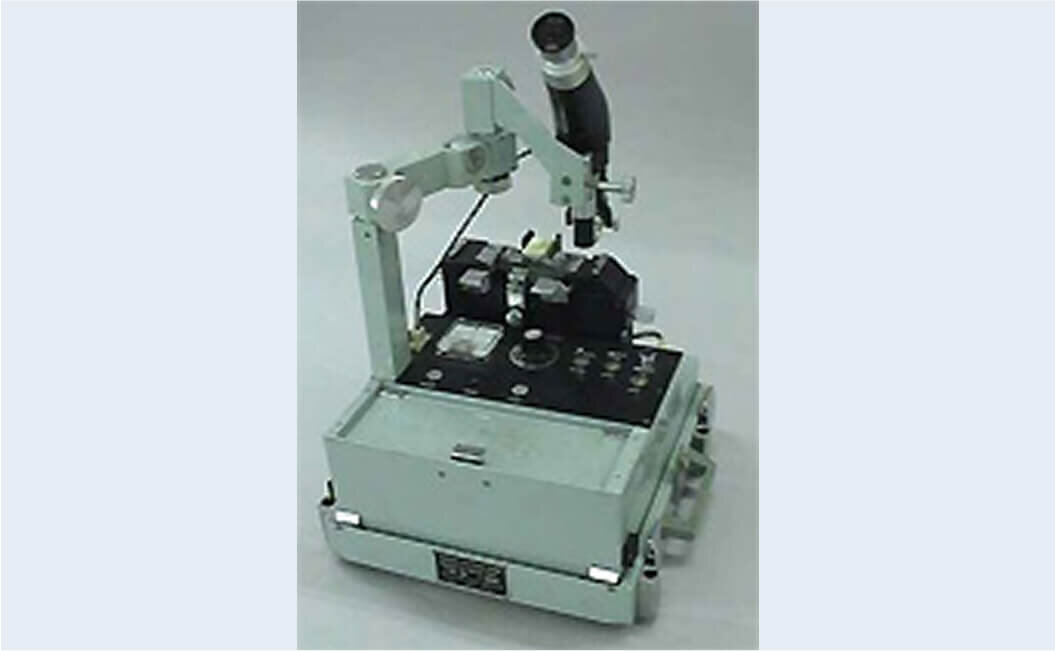
At the time, the development of Optical Fiber itself was still in the trial and error stage. In addition to its unstable structure and lack of strength, there was no analytical method for measuring transmission loss. A series of tedious experiments were conducted. There was uncertainty about the future. There was no clear path to a breakthrough. A sense of frustration grew. Amidst this dead-end situation, a ray of hope finally began to appear the following year, when the structure of Optical Fiber itself stabilized and its strength increased dramatically. Experiments were conducted with two methods: the "V-groove method," in which Optical Fiber is placed in a precision V-groove and pressed down with dripping matching oil, and the "fusion method," in which Optical Fiber is placed in the air and thermally fused with arc discharge. However, due to its superior properties and ease of use, development quickly shifted to the "fusion method." Thus, in October 1977, the first practical multimode Fusion Splicer was completed.
This machine was then exhibited at an exhibition held alongside the Optical Symposium in Washington in 1979. Although it was only a small space in a corner of the exhibition hall, it attracted a huge crowd and drew a lot of attention. There was still no demand at the time, so it did not become a business. However, it marked a world debut that would lead to a rapid advance later on, and was an epoch-making event that set the stage for the company to become number one in global market share.
-
 Vol. 01Mariana Trench RomanceThe story of cable development for the 10,000m-class unmanned exploration vehicle "KAIKO"
 -
 Vol. 02No.1 share in the worldThe story of the development of the de facto standard "Fusion Splicer"
 -
 Vol. 03A gift from GodThe story of the development of "ultra-low loss Optical Fiber" a symbol of Fujikrism
 -
 Vol. 04Technology MicrocosmThe development story of "Flexible Printed Circuits (FPC)," the key to the evolution of electronic devices
 -
 Vol. 05The Superconducting RevolutionThe story of the world's first "yttrium-based oxide superconducting wire" development
Management Philosophy


- HOME
- Company Information
- Fujikura History
- FUJIKURA ODYSSEY
- Vol.02 No.1 share in the world